
Smart Plant Enclosure
Mk1
Pilot Project · Origen Air Systems
Summary
Commercial enclosure development for a smart plant air purification system, focused on manufacturability, serviceability, and aesthetics for office environments. The project evolved from an over constrained prototype architecture into a simplified, production-oriented design assembled in house.
Project Snapshot
- Client: Origen Air Systems Ltd
- Context: Pilot product for public deployment and user feedback
- Role: Mechanical Designer (Co-op)
- Scope: Enclosure architecture, CAD ownership, manufacturing drawings, assembly leadership
- Deliverables: Sheet metal subassemblies, shop drawings, BOMs, assembled pilot units
Development
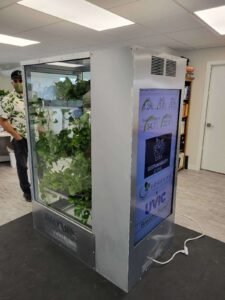
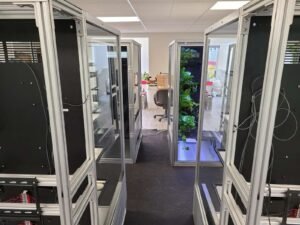
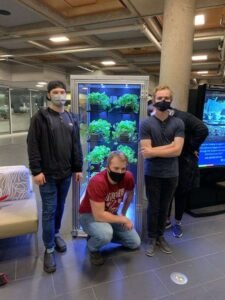
Development was guided by a manufacturing first design philosophy, prioritizing fastener consistency, modular subassemblies, and ease of in house assembly. Multiple enclosure revisions were completed to balance aesthetics, service access, and production practicality within pilot scale manufacturing constraints.
Read More
Team & Project Responsibilities
The project team consisted of five disciplines: mechanical, electrical, software, biomedical, and civil. I joined after early concept development and assumed ownership of the full mechanical assembly.
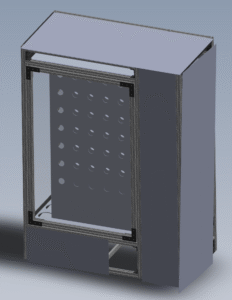
When I started, the SolidWorks assembly was unstable and difficult to modify. I rebuilt the enclosure structure, established consistent part numbering, organized BOM data, and produced a stable master assembly suitable for manufacturing and iteration.
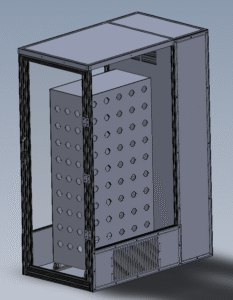
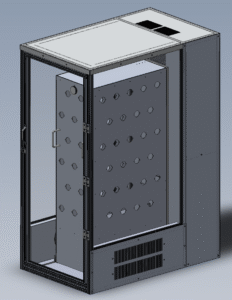
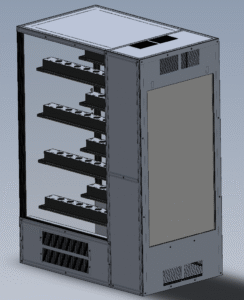
System Architecture
The enclosure housed a genetically enhanced ivy plant used for air purification, supported by internal airflow management and a secondary UV treatment chamber. The design prioritized aesthetics while allowing regular user and service access.
- Sheet metal cabinet construction
- Front-access door for plant servicing
- Multiple glass inserts for plant protection and visibility
- Internal UV chamber for secondary air treatment
- Initial use of aluminum extrusion, later phased out to reduce complexity (Mk2)
My Contributions
- Full ownership of the SolidWorks enclosure assembly
- Designed three sheet metal subassemblies and produced shop drawings and STEP files for quotation
- Coordinated fabrication with LaserCAM
- Led in house assembly of six pilot units
- Managed aluminum powder coating through JS Foster
- Established fastener standardization and modular build strategy
- Supported transition to a next-generation enclosure redesign
Read More (example files)
Challenges
- Aluminum extrusion enabled rapid prototyping but became inefficient and finicky at small production volumes
- Supply issues with specialty spring-lock hardware complicated assembly
- Fastening sheet metal into extrusion proved inconsistent and difficult to scale
- Balancing aesthetics, manufacturability, and service access within tight iteration cycles
Biggest Takeaways
- Prototyping friendly architectures do not always scale to small production runs
- Fastener standardization and hardware availability directly affect assembly efficiency
- Stable CAD assemblies and clean BOMs are prerequisites for manufacturing progress
- Designing for in house assembly exposes issues that are easy to miss in CAD alone
Project Outcomes
Six pilot units were successfully manufactured and assembled in-house for deployment and user feedback. Lessons learned from this enclosure directly informed a subsequent redesign, which was developed from the ground up with fewer revisions and improved manufacturability.